
How a Secret Mega-Bank Alliance Could Spark a Capitol Hill Showdown
A quiet chess move in the financial world is threatening to detonate a political powder keg on Capitol Hill.
A powerful consortium of the nation’s largest financial institutions—including JPMorgan Chase, Bank of America, Wells Fargo, and PNC—has held preliminary, behind-the-scenes discussions to acquire a major independent debit card routing network (STAR or Accel) from financial technology giant Fiserv.
On its surface, a bank alliance buying a piece of back-end payment infrastructure sounds like standard corporate consolidation. In reality, it is a highly calculated strike designed to bypass federal fee caps, match a massive competitive threat from Capital One, and fundamentally reshape the multi-billion-dollar card processing industry.
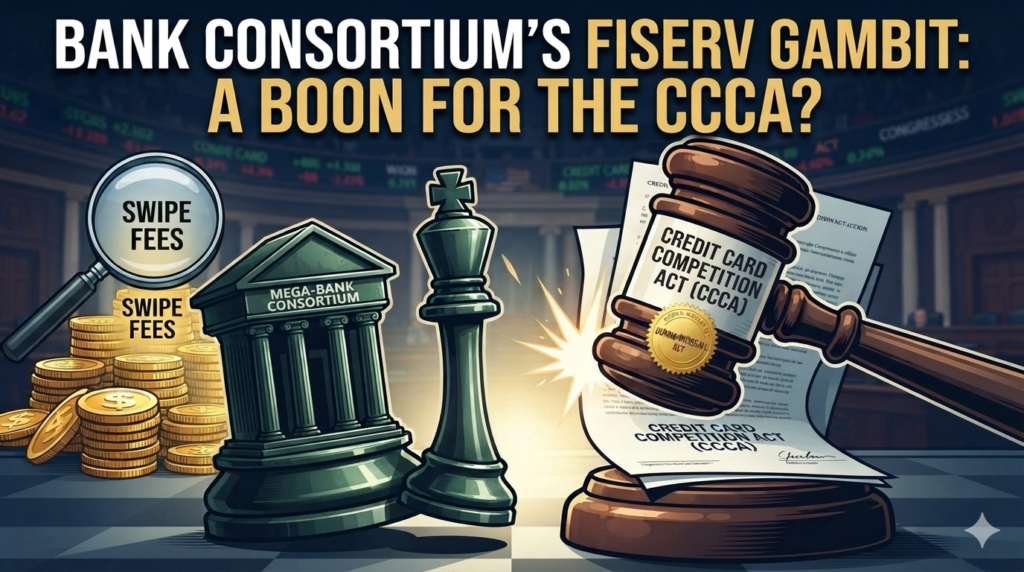
However, this secret alliance may have a massive unintended consequence: handed a loaded weapon to lawmakers pushing the fiercely contested Credit Card Competition Act (CCCA).
The Loophole: Bypassing the Durbin Amendment
To understand why the nation’s biggest banks are acting as a syndicate to buy a tech asset, you have to look back to the 2010 Dodd-Frank Act. Tucked inside that sweeping post-recession law was the Durbin Amendment, a rule that strictly caps the “swipe fees” (interchange fees) that banks with over $10 billion in assets can charge merchants every time a consumer swipes a debit card.
For over a decade, Wall Street has despised this cap, claiming it stripped away billions in revenue that previously funded free consumer checking accounts and debit reward points.
But the Durbin Amendment contains a glaring, highly specific loophole: The fee caps do not apply to a bank if that bank actually owns the payment network underpinning the transaction.
By banding together to buy an independent rail like Fiserv’s STAR network, these mega-banks could legally route their massive debit card volumes through their own proprietary infrastructure. The result? They could instantly escape government price controls and push transaction fees back toward historic, uncapped market rates.
The Catalyst: Envy Over Capital One & Discover
Wall Street isn’t just acting out of frustration with regulators; they are reacting to a shifting competitive landscape.
When Capital One acquired Discover in a blockbuster $50.6 billion deal, it completely altered the payments hierarchy. Capital One didn’t just buy a credit card issuer; they bought a closed-loop transaction network. It granted them a direct pipeline to merchants, freed them from heavy reliance on third parties, and gave them an independent infrastructure that completely bypassed conventional regulatory hurdles.
The rest of the “Big Four” looked on with envy. Realizing that a single bank buying an entire network is an incredibly rare, expensive feat, JPMorgan, BofA, Wells Fargo, and PNC opted for a team-up strategy to build a shared defensive wall against Capital One’s newfound structural advantage.
Fueling the Fire for the Credit Card Competition Act
While the economic incentives for the banks are clear, the political timing could not be worse for Wall Street’s lobbying apparatus.
Right now, Congress is locked in an intense battle over the Credit Card Competition Act, a bipartisan bill sponsored by Senators Dick Durbin and Roger Marshall. The CCCA aims to break up the Visa and Mastercard credit duopoly by forcing massive banks to offer at least two routing options on credit cards—ensuring at least one option is an independent network.
The Looming Antitrust Wall
Even if the banks brave the political blowback, clearing the regulatory hurdles will be a monumental challenge. The Department of Justice (DOJ) and the Federal Trade Commission (FTC) are aggressively hostile toward horizontal coordination among dominant market competitors.
Regulators will closely examine historical precedents, such as the landmark United States v. Visa U.S.A. case in the late 1990s, where the DOJ successfully fought to dismantle the “cooperative bank governance” structure of early payment networks. A consortium of rival banks collectively dictating the rules, pricing, and infrastructure of a major consumer payment network will instantly trigger severe antitrust red flags, including:
- Horizontal Collusion: Competitors sharing a board to manage a vital financial utility.
- Vertical Foreclosure: The risk that the owner-banks will favor their own debit transactions while choking out smaller community banks and independent routing choices.
A High-Stakes Game
This volatile intersection of business and politics is exactly why several banks involved in the preliminary Fiserv talks have reportedly started backing away.
Bank executives are beginning to realize a harsh reality: announcing a formalized acquisition of a network like STAR might successfully bypass the Durbin debit caps, but the resulting political explosion would virtually guarantee the immediate passage of the Credit Card Competition Act.
Wall Street is playing a dangerous game with Washington—and the future of how billions of everyday card transactions are processed hangs entirely in the balance.
Fintech US News Brief September 18, 2026
Payments, cryptocurrencies, and artificial intelligence. The e-commerce digital transformation is happening so fast, it’s hard to make sense of it all. My name is JP Biamby, the CEO of Merchant Advisory Services & welcome to the Fintech World News Report. We’ll give you just the facts, as simple as we can. We’ll give you a recap of all the news that made the headlines in fintech, payments, and artificial intelligence. Tune in to hear what’s new in fintech.

Fintech World News Report September 16 2026
Fintech World News Report September 16, 2026 Here’s the Fintech World News Report for September 16th, 2026. Tabby App Raises $233 raises $233 million at

Secure A Line Of Capital
Working capital for your business. Withdraw when you need it, not all at once.Funded from your revenue, not your credit score. Once approved, then you have 24 months to draw against it as you need it, paying back only what you draw. Find out what you’d be eligible for. No cost to ask. No hard credit pull to get a number.

Stark Warning on Superintelligence
An Insider’s Stark Warning on Superintelligence Host- JP BiambyCEO, Merchant Advisory Services In this special bonus episode of The Fintech Report World News Report, we
The Payment Wars
A quiet chess move in the financial world is threatening to detonate a political powder keg on Capitol Hill.A powerful consortium of the nation’s largest financial institutions—including JPMorgan Chase, Bank of America, Wells Fargo, and PNC—has held preliminary, behind-the-scenes discussions to acquire a major independent debit card routing network (STAR or Accel) from financial technology giant Fiserv.
$400 Switch and Save Offer
Book Free Analysis Free statement analysis · Limited Offer · $400 Gift Card Most merchants overpay on processing. We find what you’re owed. Send

Boost Sales With Faster Checkouts!
Boost Sales With Faster Checkouts 🚀 From slow checkouts to faster salesLong lines and slow payment processing can quietly impact revenue, customer satisfaction, and operational

The Flat-Fee Illusion: How Small Business Owners are Losing Millions in a Massive Wealth Transfer
If your small business still relies on a seemingly simple flat-fee merchant account from providers like Square, Lightspeed, Shopify, or PayPal, you need to stop and read this immediately then call Merchant Advisory Services at 646-780-0802.

AI Influence On Consumer Facing Platforms
We all know Artificial Intelligence is changing the game—from generating captivating copy to powering sophisticated recommendation engines. But have you ever stopped to think about where these brilliant brains are getting their homework done?